ERP Consulting
We help you decide whether Odoo is the right system, what it should cover first, and how to structure a project that your team…
Moving to a current Odoo version, or into Odoo from another system, without losing data, history or the customisations that matter.
Odoo releases a major version every year and supports the three most recent. A system that is left on an old version eventually loses security updates and the ability to use new features, and the gap between versions grows until an upgrade becomes a re implementation. Companies coming from another ERP face a different problem: years of data in a structure that does not map neatly onto Odoo.
We handle both. An upgrade project moves your database, your custom modules and your integrations to a current version and proves that everything still works before the switch. A migration project takes data from your old system, cleans it, maps it to Odoo and loads it in rehearsals until the numbers reconcile.
Inventory of versions, modules, customisations, integrations and data volumes. A report with the recommended approach, risks and estimate.
Code migration or replacement, data mapping and cleaning, and the first test upgrade or test load.
Repeated test upgrades or loads on a copy of production, each followed by user testing and reconciliation, until the checklist is clean.
A planned switch with a rollback option, followed by hypercare and handover to the managed service.
We have worked with data from spreadsheets, accounting packages and older ERP products. The method is the same in each case: understand the structure, agree what is worth moving, and reconcile. If you are considering a move to Odoo, our guide on data migration explains what to prepare before the project starts.
Odoo releases a major version every year and supports the three most recent. Most of our clients upgrade every one to two years, which keeps each upgrade small. Falling several versions behind turns an upgrade into something closer to a re implementation.
An assessment of your modules, customisations and integrations; migration or replacement of custom code; repeated test upgrades of a copy of your production database; user testing of every process against a checklist; and a planned cut over with a rollback option. Enterprise customers use Odoo's upgrade service for the standard data; we handle the code and the testing.
Custom modules must be migrated to the new version, and we review each one against the new standard features. Some are kept, some are replaced by configuration and some are retired. Studio changes are usually carried automatically but are tested like everything else.
Yes. We have moved data from spreadsheets, accounting packages and older ERP products. The method is the same: agree what moves, clean the master data, map it, load it in rehearsals and reconcile balances and open items before go live. Our data migration guide sets it out in detail.
Usually keep it accessible in the old system in read only mode or in an archive, and load only opening balances and open items into Odoo. Migrating years of closed transactions is expensive and rarely used. We help you decide per data set.
We help you decide whether Odoo is the right system, what it should cover first, and how to structure a project that your team…
A structured implementation that fits your processes to standard Odoo wherever possible, and delivers each module with the people who will use it.
We connect Odoo to the tools around it and automate the repetitive steps inside it, from order to cash and from purchase to pay.
What Odoo Studio does well, where it causes problems, and the rules we apply before adding a field, view or automation with it.
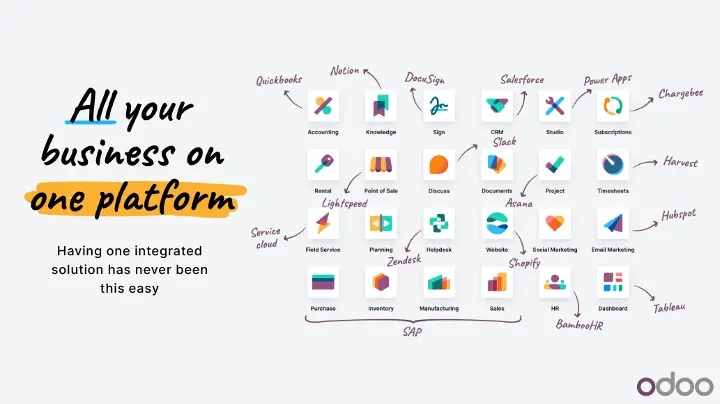
Odoo ERP is an integrated business management platform that brings different business functions into one system. It includes applications for accounting, sales, CRM, inventory,…
A practical method for the discovery workshops that shape an Odoo implementation: attendees, agenda, questions and outputs.