eCommerce and Retail
Odoo for online and physical retail: connected shops, accurate stock across channels, fast fulfilment and clean accounts.
Odoo for firms that sell time and expertise: from quote to project to timesheet to invoice, with margin visible throughout.
Agencies, consultancies, engineering firms and IT service providers share a problem: the work is done by people, and people are the main cost. If time is recorded in one tool, projects planned in another and invoices raised in a third, nobody knows the real margin on an engagement until long after it ends.
Odoo connects the sales pipeline to projects, projects to timesheets, and timesheets to invoices and cost accounting. A sales order can create the project and its tasks. Hours logged against those tasks can be billed at the agreed rate or on a fixed fee schedule. Costs, revenue and margin appear per project as the work happens.
Engagement types, contract models, rate cards, current tools and reporting needs.
CRM, quotation templates, project templates, timesheet rules and invoicing configuration.
One team runs a live engagement in Odoo end to end while others continue as before.
Remaining teams onboarded by service line, with training and historical projects migrated where they are still open.
A focused first phase covering sales, invoicing or accounting, inventory and purchasing for a single company typically runs a few months from discovery to go live. Adding manufacturing, eCommerce, projects or several legal entities extends that. The largest factors are the number of processes, the state of your data and how much time your team can give the project. We give you a timeline with the roadmap and update it at every phase boundary.
Usually not. We recommend going live with the core apps first, because that is where the data flows connect, and adding further apps in later phases once the core is stable. For groups, roll out is typically entity by entity using the first as a template. A single big go live is possible when the business needs it, but it carries more risk and needs more preparation.
More than most people expect. A project lead needs at least two days a week. Each key user needs time for workshops, testing and training, which can add up to several days per module. We estimate these hours per role and per phase in the roadmap so that managers can plan for them.
Where there is a clear business case, yes. Our default is to configure standard Odoo first, use existing modules second and write code last. Every customisation is documented with the reason it exists, because each one adds cost at every future upgrade.
Per module and per role, close to the point of use. Key users are trained as each module is configured and they in turn test it. End users are trained before go live with sessions, recordings and short written guides that you keep. We avoid a single large session a week before launch.
A hypercare period with daily contact for the first weeks, followed by handover to our managed service if you want ongoing support, or to your internal team with documentation and a knowledge base.
Odoo for online and physical retail: connected shops, accurate stock across channels, fast fulfilment and clean accounts.
Odoo Manufacturing, Inventory, Purchase and Quality configured for make to order, make to stock and subcontracted production.
Larger organisations use Odoo across multiple legal entities with shared master data, intercompany automation and group reporting.
What Odoo Studio does well, where it causes problems, and the rules we apply before adding a field, view or automation with it.
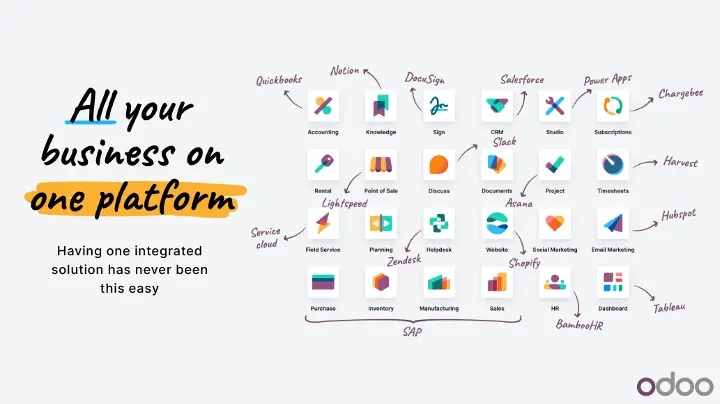
Odoo ERP is an integrated business management platform that brings different business functions into one system. It includes applications for accounting, sales, CRM, inventory,…
A practical method for the discovery workshops that shape an Odoo implementation: attendees, agenda, questions and outputs.