eCommerce and Retail
Odoo for online and physical retail: connected shops, accurate stock across channels, fast fulfilment and clean accounts.
Planning, production, quality and logistics in one system, with costs that reflect what actually happened on the shop floor.
Manufacturers usually arrive at Odoo with a planning spreadsheet that has become too important to touch. Bills of materials live in one place, purchase orders in another, and the true cost of a finished product is a matter of opinion. Odoo brings those threads together, but only if the master data and the routing are set up with care.
We implement Odoo for discrete manufacturers, assemblers and companies that subcontract production. The scope typically covers bills of materials, work centres and routings, manufacturing orders, material planning, purchasing, quality checks, warehouse operations and the accounting that values it all.
Product structures, production methods, planning practice, purchasing and costing approach, reviewed with production, purchasing and finance.
Products, bills of materials, routings, suppliers and locations cleaned and loaded into a test database.
Planning, manufacturing, purchasing, quality and warehouse flows built and tested on real orders.
Usually at a stock count, so that opening quantities and valuations are agreed on the first day of the new system.
A focused first phase covering sales, invoicing or accounting, inventory and purchasing for a single company typically runs a few months from discovery to go live. Adding manufacturing, eCommerce, projects or several legal entities extends that. The largest factors are the number of processes, the state of your data and how much time your team can give the project. We give you a timeline with the roadmap and update it at every phase boundary.
Usually not. We recommend going live with the core apps first, because that is where the data flows connect, and adding further apps in later phases once the core is stable. For groups, roll out is typically entity by entity using the first as a template. A single big go live is possible when the business needs it, but it carries more risk and needs more preparation.
More than most people expect. A project lead needs at least two days a week. Each key user needs time for workshops, testing and training, which can add up to several days per module. We estimate these hours per role and per phase in the roadmap so that managers can plan for them.
Where there is a clear business case, yes. Our default is to configure standard Odoo first, use existing modules second and write code last. Every customisation is documented with the reason it exists, because each one adds cost at every future upgrade.
Per module and per role, close to the point of use. Key users are trained as each module is configured and they in turn test it. End users are trained before go live with sessions, recordings and short written guides that you keep. We avoid a single large session a week before launch.
A hypercare period with daily contact for the first weeks, followed by handover to our managed service if you want ongoing support, or to your internal team with documentation and a knowledge base.
Odoo for online and physical retail: connected shops, accurate stock across channels, fast fulfilment and clean accounts.
Project based businesses use Odoo to plan work, record time, bill accurately and see which engagements actually make money.
Larger organisations use Odoo across multiple legal entities with shared master data, intercompany automation and group reporting.
What Odoo Studio does well, where it causes problems, and the rules we apply before adding a field, view or automation with it.
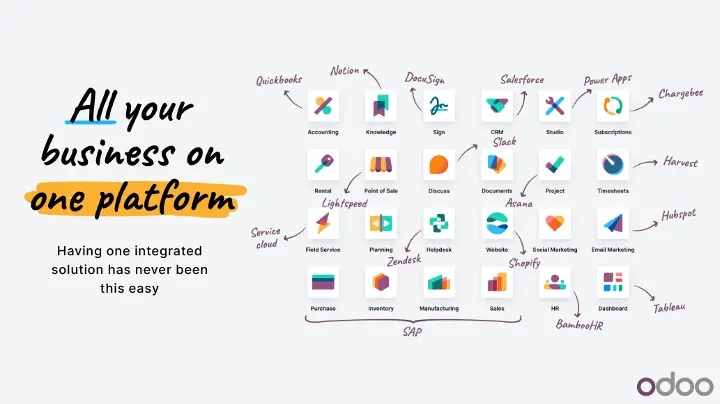
Odoo ERP is an integrated business management platform that brings different business functions into one system. It includes applications for accounting, sales, CRM, inventory,…
A practical method for the discovery workshops that shape an Odoo implementation: attendees, agenda, questions and outputs.