ERP Consulting
We help you decide whether Odoo is the right system, what it should cover first, and how to structure a project that your team…
From signed scope to a live system your team uses every day, with training, testing and data migration built into every phase.
A new ERP is a large amount of work for the company receiving it. Your staff have to describe their processes, clean their data, learn a new system and keep the business running at the same time. An implementation partner earns its fee by taking as much of that load as possible and by making the rest predictable.
We implement Odoo module by module, in the order that gives you the most relief soonest. Each module goes through the same cycle: a workshop, a configuration, a test with real data, a training session and a sign off. Nothing goes live because a date arrived. It goes live because the people who own that process have tested it and agreed.
Requirements workshops per business unit, a gap analysis against standard Odoo, a target concept and an estimate. If you have already completed ERP consulting with us, this phase is shorter.
Instances, users, companies and base data are prepared. Each app starts with a workshop in which we run your process end to end in Odoo and agree the configuration.
We configure standard Odoo first. Custom developments and integrations follow the concept and are documented as they are built.
Data is cleaned and loaded into a test database. We test internally, walk your key users through each process, then run user acceptance testing across a complete business cycle.
A cut over plan with a rollback option, a go live weekend or evening as your business needs, and daily support for the first weeks.
When hypercare ends, the system moves into our managed service if you want it: support, maintenance, new features and training on demand.
Most projects start with Sales, CRM, Invoicing, Accounting, Inventory and Purchase, because that is where the data flows connect. Manufacturing, Project, Timesheets, Helpdesk, eCommerce, Point of Sale and the HR apps follow when the core is stable. We will tell you plainly if an app is not mature enough for your use case in your version, and what the alternative is.
A focused first phase covering sales, invoicing or accounting, inventory and purchasing for a single company typically runs a few months from discovery to go live. Adding manufacturing, eCommerce, projects or several legal entities extends that. The largest factors are the number of processes, the state of your data and how much time your team can give the project. We give you a timeline with the roadmap and update it at every phase boundary.
Usually not. We recommend going live with the core apps first, because that is where the data flows connect, and adding further apps in later phases once the core is stable. For groups, roll out is typically entity by entity using the first as a template. A single big go live is possible when the business needs it, but it carries more risk and needs more preparation.
More than most people expect. A project lead needs at least two days a week. Each key user needs time for workshops, testing and training, which can add up to several days per module. We estimate these hours per role and per phase in the roadmap so that managers can plan for them.
Where there is a clear business case, yes. Our default is to configure standard Odoo first, use existing modules second and write code last. Every customisation is documented with the reason it exists, because each one adds cost at every future upgrade.
Per module and per role, close to the point of use. Key users are trained as each module is configured and they in turn test it. End users are trained before go live with sessions, recordings and short written guides that you keep. We avoid a single large session a week before launch.
A hypercare period with daily contact for the first weeks, followed by handover to our managed service if you want ongoing support, or to your internal team with documentation and a knowledge base.
We help you decide whether Odoo is the right system, what it should cover first, and how to structure a project that your team…
We connect Odoo to the tools around it and automate the repetitive steps inside it, from order to cash and from purchase to pay.
A monthly service that keeps your Odoo running, resolves user questions, applies updates and adds the functionality your business needs next.
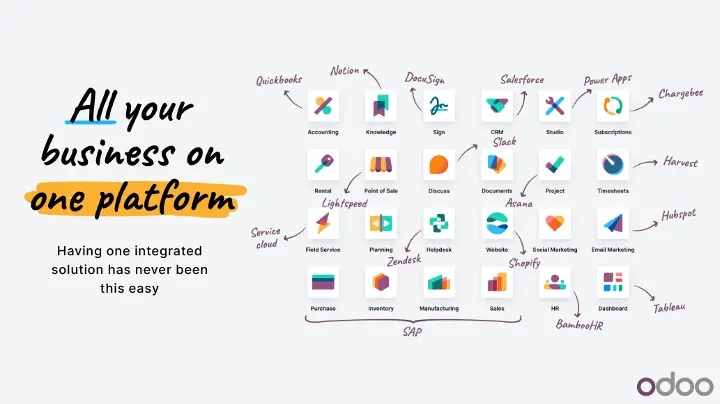
Odoo ERP is an integrated business management platform that brings different business functions into one system. It includes applications for accounting, sales, CRM, inventory,…
A practical method for the discovery workshops that shape an Odoo implementation: attendees, agenda, questions and outputs.
A comparison of Odoo Online, Odoo.sh and self hosting on the questions that matter: customisation, upgrades, control and responsibility.