eCommerce and Retail
Odoo for online and physical retail: connected shops, accurate stock across channels, fast fulfilment and clean accounts.
Odoo for groups with several companies, countries and currencies, where consolidation, controls and governance matter as much as features.
Odoo is often thought of as a system for small companies. It is also used by groups with many legal entities, and the way it handles multiple companies in one database makes it a practical choice for that structure. What changes at this scale is the weight of governance: who can see what, how intercompany transactions are handled, how the group reports, and how change is controlled once dozens of departments depend on the system.
We work with groups on the design that makes multi company Odoo work: the company structure, the chart of accounts, shared and local master data, access rights, intercompany rules and the reporting layer. We also bring the project discipline that larger organisations expect, including formal change control and documented decisions.
Company structure, chart of accounts, master data ownership, intercompany model, reporting requirements and governance, agreed with group finance and IT.
The first entity is implemented as the template, with every configuration decision documented.
Further entities are onboarded in waves, each with local tax and legal configuration, data migration and training.
The group moves into managed service with a change board that approves configuration changes across entities.
Yes. We act as an independent project manager alongside another Odoo partner or an internal team. Roles and responsibilities are set out in writing at the start so that there is no ambiguity about who owns what.
Deciding who is affected by the new system and how their work changes, telling them why the change is happening before telling them how, training them by role close to go live, and checking that each department is ready before the date is confirmed. It is planned from the first week of the project rather than added when adoption problems appear.
Every change request is estimated, its effect on the plan and budget is shown, and the sponsor decides. Nothing is added to the scope by agreement in a workshop alone. This is uncomfortable in the moment and saves the project later.
A short written status every week: what was done, what is next, what is at risk and what decisions are needed. Steering meetings at each milestone review the plan, the budget and the risk register.
We start with a short review of scope, plan, decisions, data and readiness, and give you a written view of what is wrong and what it would take to recover. Recovery usually means narrowing the first go live and rebuilding the plan around readiness rather than a date.
Odoo for online and physical retail: connected shops, accurate stock across channels, fast fulfilment and clean accounts.
Project based businesses use Odoo to plan work, record time, bill accurately and see which engagements actually make money.
Odoo Manufacturing, Inventory, Purchase and Quality configured for make to order, make to stock and subcontracted production.
What Odoo Studio does well, where it causes problems, and the rules we apply before adding a field, view or automation with it.
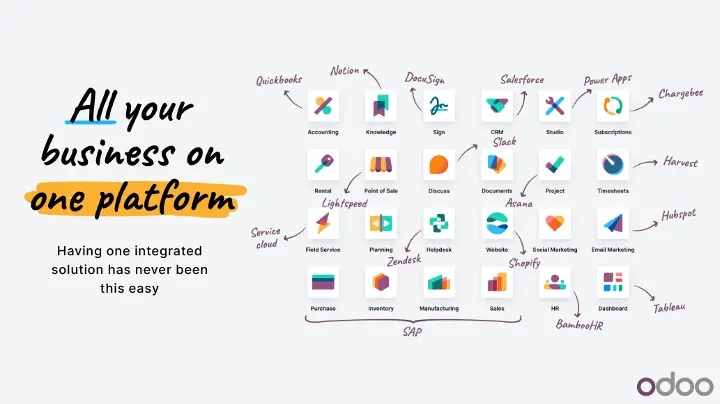
Odoo ERP is an integrated business management platform that brings different business functions into one system. It includes applications for accounting, sales, CRM, inventory,…
A practical method for the discovery workshops that shape an Odoo implementation: attendees, agenda, questions and outputs.